Birdcage
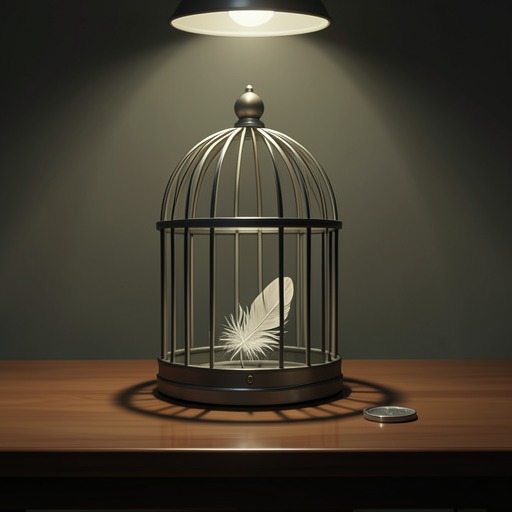
Breakfast at Tiffany'sThe Birdcage is a lavish, three-hundred-and-fifty-dollar object whose meaning shifts with its place in Holly Golightly and the narrator’s relationship. It begins as a fantastical display behind a shop window, becomes Holly’s extravagant Christmas present to the narrator, and later passes between their doorways and the rubbish as they fall out. Holly’s insistence that it never hold a living thing gives its ornamental form an unsettling force: what looks like a palace is still a cage, and what is given as a gift becomes a stubborn relic of separation.
Appearance and First Encounter
The narrator first sees the Birdcage in the window of an antique shop on Third Avenue near Fifty-first Street, during a hot summer night when the heat of his room has driven him outdoors. He imagines it as a palace, even a mosque: minarets and bamboo rooms seem to invite the talkative parrots that might inhabit them. Its three-hundred-and-fifty-dollar price, however, makes the vision inaccessible. At this point, the object is both a beautiful fantasy and a conspicuous luxury—something admired from the street, not yet part of either neighbor’s life.
Later, while looking for peanut butter for Fred, the narrator takes Holly to the same shop. She enjoys the Birdcage’s fantastic design, but punctures the fantasy with a plain observation: “But still, it’s a cage.” Her response does not erase its beauty; it places beauty and confinement in the same frame. The remark anticipates the meaning she will give the object when she buys it for the narrator, while also establishing that its grand, palace-like appearance cannot disguise its basic function as an enclosure.
The Christmas Present
On Christmas Eve, Holly and Mag host a party, and Holly asks the narrator to arrive early to help trim the tree. It is so large that its top branches are crushed against the ceiling and its lower ones spread from wall to wall. Holly sends herself to Woolworth’s to steal balloons, which help turn the oversized tree into a festive display. After the pair toast their work, she directs the narrator to a present in the bedroom: the Birdcage, wrapped with a red ribbon and set squarely on the bed.
The gift brings the Birdcage into the narrator’s home but also makes visible the disparity between its price and the modest present he has brought for Holly. He protests that it is dreadful, and she agrees with him; he then exclaims over its cost. Holly merely shrugs and explains that it took “A few extra trips to the powder room.” The casual explanation connects the costly object to the way she earns money without spelling out the transactions, and contrasts the Birdcage’s expensive permanence with the disposable means by which she paid for it.
The narrator tries to kiss her, but Holly instead holds out her hand for his gift. It is a St. Christopher medal, small enough to seem meager beside the Birdcage, though the narrator notes that it at least came from Tiffany’s. The gifts are thus unequal in size and price, but each carries a particular association: his medal comes from the refuge he values, while her purchase fulfills his long-standing admiration for the object in the shop window.
A Gift with a Condition
Holly’s present comes with a request: the narrator must promise never to put a living thing inside the Birdcage. The condition distinguishes the object from a usable home for a pet or bird. Its ornamental appeal can remain, but its apparent purpose must not be enacted; the cage is to be possessed and looked at, not occupied. Holly’s earlier recognition that it is still a cage gives the request a pointed consistency.
That insistence also frames the Birdcage as more than a decorative present. The narrator receives a beautiful object whose form names confinement, while Holly refuses to let that confinement contain a living creature. The text does not turn the Birdcage into a simple emblem or spell out Holly’s motive. Instead, the contrast between its elaborate, inviting architecture and her prohibition leaves the gift suspended between fantasy and restriction, attachment and the refusal to possess.
The Falling-Out and the Object’s Return
After a winter trip in February with Rusty, Mag, and José Ybarra-Jaegar, Holly returns sun-browned, with hair bleached almost ghost-white. Her stories of the trip include trouble in Key West, Mag’s hospitalization with sunburn, and a journey to Havana with José. Soon afterward, Holly and the narrator have a major falling-out. The narrator recalls that the Birdcage, O. J. Berman, and a copy of his story that he had given Holly all revolved within what he calls the eye of their hurricane: several pieces of their shared life become entangled in the dispute.
In the aftermath, the narrator goes upstairs, retrieves the Birdcage, and leaves it in front of Holly’s door, thinking that this settles the matter. By the next morning, she has placed it on a sidewalk ashcan for the garbage collector. The gift has been rejected in return, but the narrator cannot leave it there. As he goes to work, he sheepishly rescues it and carries it back to his room. The small reversal makes the object’s physical presence consequential: even as he resolves to put Holly entirely out of his life, he acts to preserve something she gave him.
The narrator’s decision to keep the Birdcage does not immediately repair their friendship. He calls Holly a crude exhibitionist, a time waster, and an utter fake, and for a long while the two pass one another on the stairs with their eyes lowered. If she enters Joe Bell’s, he leaves. The Birdcage survives in his room while their ordinary contact falls away, so its continued presence records not a reconciliation but the stubborn residue of a connection he has chosen to disavow.
Survival and Narrative Significance
The narrator later says that the Birdcage is still his, although he seldom remembers that Holly gave it to him because, at one point, he chose to forget. Unlike the St. Christopher medal, which he supposes Holly has lost in a suitcase or hotel drawer, the Birdcage has accompanied him through moves and journeys: to New Orleans, Nantucket, Europe, Morocco, and the West Indies. Its continued survival is not proof that the friendship remained intact. Rather, the object outlasts the narrator’s conscious effort to separate it from Holly and from their falling-out.
That endurance sharpens the contrast between the Birdcage and its intended living occupants. It travels widely but remains empty, and it is repeatedly moved rather than inhabited: from the antique-shop window to the narrator’s bedroom, to Holly’s doorway, onto an ashcan, and back into the narrator’s room. Its path gives material form to the unstable balance between possession and release in their relationship. Holly can buy the object and then discard it; the narrator can declare the relationship over, yet still retrieve the gift. The Birdcage remains at once an elegant fantasy, a confinement Holly refuses to populate, and a durable reminder of an attachment the narrator cannot wholly put away.